Humans of Staffing
Welcome to Humans of Staffing, where we explore the untold stories of the staffing industry’s most interesting leaders and innovators. Join hosts Sammy Singh and TJ Sehmi as they unpack real experiences from agency owners, operators, and the talent that powers the industry. From celebrating customer success stories to diving deep into technology trends like AI adoption, each episode brings authentic conversations about what’s really happening in staffing. Whether you’re running an agency or looking to modernize your operations, you’ll discover valuable insights from those building the future of staffing.
Listen on:



Episodes

Thursday Nov 20, 2025
Thursday Nov 20, 2025
What does it take to place temporary workers on billion-dollar naval vessels where internet connectivity doesn't exist, credentials expire weekly, and a falling piece of metal from 80 feet can be fatal? Jay Prock runs Tidewater Staffing, a family operation that deliberately fights growth for growth's sake to maintain the quality and safety standards that keep 3,000-4,000 people working annually in Virginia's ship repair and shipbuilding industry.
After buying the company from his father in 2018, Jay discovered that the real competitive advantage wasn't technology or scale. It was overstaffing with onsite coordinators who physically walk temps from pier to vessel, hand them safety glasses when they forget them at 5:36 AM, and maintain relationships that keep workers from letting down someone they know personally. This approach, combined with mandatory six-point suspension hard hats with chin straps after a near-fatal incident, has created 82% participation in healthcare benefits where industry standard is closer to 5%.
Jay's contrarian philosophy, inspired by Bo Burlingham's "Small Giants," rejects geographic expansion and vertical diversification in favor of becoming the best operation in a single port. The result is $17,000 spent on hoodies for temps, training facilities with mock shipboard environments, and success stories like a laborer starting at $7.35/hour who exited a $22 million private equity sale as part owner.
Topics discussed:
Overstaffing onsite coordinator roles to provide manual touchpoints where Wi-Fi and internet connectivity don't exist on naval vessels
Managing two-week credentialing processes requiring DVIDS access, MARMAC ship lists, and maritime OSHA 10-hour certifications for entry-level positions
Implementing upgraded six-point suspension hard hats with chin straps after incident where falling metal knocked off traditional four-point hard hat
Running proprietary training programs modeled on AMP (Association for Materials Performance and Preservation) to upskill fire preventers into coatings roles
Achieving 300-350 weekly healthcare benefit participants (out of 600 field workers) using pre-tax dollar algorithm that only enrolls if marginal pay increases
Rejecting growth opportunities outside ship repair, shipbuilding, logistics, and manufacturing in Southeast Virginia to maintain service quality
Serving on Virginia Ship Repair Foundation Board to create endowment fund and scholarships for industry workforce development
Dividing family business responsibilities with sister (13 months younger) handling HR and workers comp while managing finances and customer relationships

Friday Nov 07, 2025
Friday Nov 07, 2025
Instant Teams maintains 18% annualized attrition in customer experience roles where the industry averages 40-60%. The difference isn't compensation structure or benefits packages. It's building around military spouses who treat remote work as their career identity anchor while relocating every two to three years.
Liza Rodewald, a former software engineer turned CEO, explains how she built a customer experience marketplace that solves a structural problem: military spouses aren't a protected class, so you can't specifically recruit them. Her solution was building a mobile app and community that organically fills the talent pool with military spouses before roles get posted. The unexpected advantage: US citizens working globally across every timezone on military bases, which are technically US soil even in Germany or Japan.
The conversation reveals how Instant Teams structures three revenue streams (BPO services, SaaS job board, brand activations), why Liza required every corporate employee to complete Google AI certification for baseline knowledge, and how they're positioning tier-two and tier-three support roles as AI eliminates tier-one. The key insight: whoever owns the training data and implementation expertise wins as customers struggle to train their own models.
Topics discussed:
Skills-based assessment system that translates frequent job changes into CX capabilities
Three revenue stream model: BPO margins, SaaS subscriptions, brand activation fees
Mobile app strategy that creates community stickiness and continuous engagement
Military base advantage providing US payroll and compliance across global timezones
Company-wide Google AI certification mandate establishing shared knowledge baseline
Tier-two positioning strategy as AI automates frontline support and chatbot functions
Training data ownership as service offering for customers implementing AI tools
Partner evaluation framework testing subject matter depth, technical capability, and financial viability
Seasonal staffing model working through annual returning worker relationships
Finance and cap table mechanics as primary learning gap for technical founders

Thursday Oct 16, 2025
Thursday Oct 16, 2025
RPO sales cycles run upwards of 18 months because these deals require buy-in from the top down,not the transactional "I need 10 temps, sign a contract tomorrow" motion of traditional staffing. The primary failure point: nine times out of 10, clients aren't prepared for the recruiting methodology and process that sits way outside the comfort zone of most hiring managers. After building an RPO practice from zero to over 50 recruiters during her 10-year tenure, Chloe was brought in by WSI six months ago to build TalentSync as deal minimums collapsed from 1,500+ annual hires to 250.
Cost-per-hire pricing at 3-5% of salary replaced the 25% direct hire model, but retention guarantees create friction when hiring managers reject candidates at day 9 of 10-day windows specifically to avoid costs. The 2021-2022 period delivered triple to quadruple EBITDA growth before collapsing at the end of 2022, with many healthcare-focused RPO firms that launched during the boom since gone under. The industry splits 50-50 on whether we're six months from fully AI-driven talent acquisition or if humans will always make the final hiring decision.
Topics discussed:
18-month sales cycles requiring top-down buy-in versus transactional staffing
Change management as primary RPO failure point in 9 out of 10 implementations
Market shift from 1,500+ hire minimums to 250-hire mid-market deals
Hiring manager behavior rejecting candidates at day 9 to avoid guarantee costs
Cost-per-hire at 3-5% of salary versus 25% direct hire fees
Recruiter relationships as what keeps long-standing RPO engagements intact
Triple-to-quadruple EBITDA growth in 2021-2022 followed by end-of-2022 collapse
Healthcare RPO provider failures post-COVID boom
AI liability exposure under client brand operations with state-specific compliance
Industry 50-50 split on six-month timeline to fully automated talent acquisition

Thursday Oct 02, 2025
Thursday Oct 02, 2025
When your job vanishes with two hours' notice and your computer gets shut off mid-pandemic, you discover what you're really made of. Gary E. Benedik transformed that June 2020 gut punch into Arch Advisory Group, then sold it to Avenica; where he's now slashing headcount by 50% while scaling operations through behavioral assessment technology.
Gary walks Sammy and TJ through Avenica's data-driven approach: their HAALO assessment maps candidates to one of 22 behavioral personas, completely bypassing traditional resume screening. The foundation? A Manpower-Google-Cognizant study that found zero statistical correlation between resume content and actual job performance. By requiring both candidates and hiring managers to complete assessments, they're generating objective compatibility scores and eliminating what Gary calls "interview theater": The subjective performances that tell you nothing about actual job capability.
From touching over a million candidates annually at Sears to building Scout Exchange's AI marketplace connecting 3,500 staffing firms, Gary brings a battle-tested perspective on where machine learning creates real value versus expensive complexity in talent operations.
Topics discussed:
Avenica’s HAALO 22-persona behavioral mapping system
Zero resume-to-performance correlation findings
Bilateral assessment methodology for objective matching
Performance data loops refining placement algorithms
Trade skills versus call center automation timeline
High-volume same-skillset hiring optimization
Data infrastructure preceding recruiting operations
Talent-first versus passion-first career mapping

Thursday Sep 18, 2025
Thursday Sep 18, 2025
Former Microsoft and Yahoo executive David Windley explains how his AI sourcing startup maintains trust through architectural design choices that keep humans in control of hiring decisions. His approach addresses the core challenge facing staffing leaders: deploying AI that accelerates sourcing without introducing bias or losing candidate quality control.
Topics discussed:
Human-in-the-loop architecture implementation: Windley's specific system design where AI handles candidate discovery and assessment but humans retain all approval decisions, creating checkpoints that prevent algorithmic bias from affecting hiring outcomes
Semantic search advancement beyond Boolean logic: How large language models enable contextual resume comprehension versus rigid keyword matching, allowing AI to understand work experience nuances that traditional ATS systems miss
Trust framework for AI adoption: Why keeping humans as final decision-makers addresses recruiter concerns about AI reliability while still capturing productivity gains from automated candidate screening and assessment
Small firm market penetration strategy: Targeting the 1-4 partner recruiting firms that represent 80-85% of the search industry, plus planned distribution through PEO channel partnerships for faster market entry
AI interview capability roadmap: Windley's technical assessment that screening interviews (information gathering) will be automated before complex conversational interviews, based on current large language model capabilities
Executive hiring failure analysis: Why C-suite candidates typically fail due to political self-interest rather than technical competency, and how this pattern reveals itself over time despite skilled interview performance
LinkedIn's competitive constraints: How their social media engagement model (withholding contact information, forcing in-platform messaging) prevents optimal recruiting tool development, creating market opportunities for specialized AI solutions
Culture assessment methodology: The "as appropriate" interviewer framework that embeds dedicated culture evaluators in every interview loop, separate from technical screening, to ensure organizational fit

Tuesday Aug 26, 2025
Tuesday Aug 26, 2025
In this episode of Humans of Staffing, Jeremy Langevin, CEO of Horizontal Talent, demonstrates how his nearly $200 million firm successfully implements AI at scale while preserving the human elements that drive recruitment success. He reveals the tactical framework for "human-in-the-loop" AI deployment, where voice agents handle 20,000 candidate pre-screens simultaneously while recruiters focus on storytelling, empathy, and cultural assessment—the irreplaceable human capabilities that close deals.
Topics discussed:
Human-in-the-loop AI framework: Defining what AI excels at (scale data analysis, standardized processes) versus uniquely human capabilities (storytelling, empathy, persuasion) to create optimal task allocation within recruitment workflows.
Voice AI implementation at enterprise scale: Deploying conversational AI agents that contact candidates within 60 seconds of application, conducting full pre-screens and scoring prospects to surface top candidates—enabling simultaneous evaluation of 5,000-20,000 applicants versus traditional sequential screening.
The 70% effectiveness threshold: Understanding that AI implementations delivering up to 70% effectiveness represent significant wins, requiring iterative refinement rather than expecting plug-and-play perfection from emerging technologies.
Cultural assessment as human differentiator: Positioning recruiters for final-mile activities including cultural alignment evaluation, relationship building, and persuasion—the high-value interactions that determine placement success after AI handles initial screening.
Generational acceptance patterns: Navigating candidate demographics where college graduates increasingly expect AI-first interactions, with recent graduates reporting their last four job interviews began with AI screening rather than human contact.
Sequential international expansion methodology: Building global operations across India, Malaysia, and Australia by leveraging existing US client relationships with overseas centers, creating natural bridges to local market opportunities while moving up the value chain.
Managing multi-currency complexity: Handling clients headquartered in Germany with operations in Malaysia while managing currency fluctuation impacts on margins, plus the sophisticated finance organization required for international operations.
Future workforce composition prediction: Preparing for a management structure where leaders oversee both human employees and digital agents, with the expectation that 30-50% of teams could be AI agents within 5-7 years across suitable roles and industries.

Thursday Jul 24, 2025
Thursday Jul 24, 2025
In this episode of Humans of Staffing, Jay Mattern, CEO of TerraFirma Marketing, dissects his cautionary tale of selling to William E. Simon's private equity fund in 1999, watching outside investors destroy operational excellence, and executing a strategic buyback through bankruptcy court. After building a staffing empire from a house-based startup to $250+ million over 32 years, Mattern reveals why investor-led management fails in staffing and the specific frameworks founder-operators use to scale successfully.
Topics Discussed:
The Six-Point Scaling Framework for Breaking Revenue Ceilings: Mattern's systematic approach to identifying structural breakdowns at major growth markers (25M, 50M, 100M+) - covering organizational hierarchy audits, role-to-person fit analysis, communication system redesigns, and accountability restructuring that enables companies to "jump the canyon" rather than hit organic growth walls.
The William E. Simon Private Equity Disaster: How Mattern's 1999 sale to the former Treasury Secretary's fund unraveled when investors prioritized quick exits over operational expertise, leading to a dot-com market crash that dropped their IPO from $75 to $25 strike price, and Mattern's envelope-back buyback negotiation before ultimately reacquiring at 107% of receivables through bankruptcy court in 2003.
Risk Management as Revenue Driver: His deployment of six dedicated risk prevention managers across territories who initiated claim management on day-one of injuries, often outperforming TPAs through deep state law knowledge and aggressive maximum medical improvement protocols - turning workers' comp from cost center to competitive differentiator.
Pre-Saturation Market Dynamics (1987-1990s): Operating in an era with under 1,000 total staffing firms (versus today's 25,000+), achieving 70% industrial markups, and executing the two-stage sale process: first selling the staffing concept to unfamiliar prospects, then selling your firm over the handful of existing competitors like Manpower and Kelly.
Strategic AI Deployment Framework: Mattern's "begin with the end in mind" methodology for AI adoption, contrasting deliberate use cases (blog outlining, research acceleration) with competitive mimicry, and his agency's positioning strategy that uses AI for efficiency while maintaining human expertise for original content creation to avoid client commoditization.
The Founder Delegation Framework That Actually Scales: Why most staffing agencies plateau when founders can't transition from operational execution to strategic oversight, including Mattern's methodology for identifying when long-term contributors have been organizationally outpaced and his approach for redeploying valuable employees whose roles have evolved beyond their capabilities.
Why Investor-Led Management Destroys Staffing Operations: The fundamental disconnect between private equity's portfolio approach and staffing's relationship-intensive, market-timing dependent business model - including why investors "didn't want to own a staffing firm" and prioritized exits over sustainable growth, leading to the prepackaged asset sale through bankruptcy court.
Multi-Dimensional Marketing Strategy for Staffing: His "shotgun not rifle" approach addressing multiple audience segments simultaneously, explaining why single-channel strategies (email-only, LinkedIn-only) fail in staffing's relationship-driven environment and the comprehensive touchpoint matrix required for sustained growth.
Listen to more episodes:
Apple
Spotify
YouTube
Wednesday Jun 18, 2025
Wednesday Jun 18, 2025
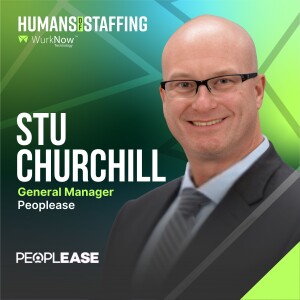
Most staffing agencies hit an invisible wall when trying to expand geographically because the compliance complexity of managing workers compensation, payroll regulations, and state-specific requirements across multiple jurisdictions becomes overwhelming. Stu Churchill, General Manager at Peoplease, however, has spent nearly two decades perfecting a co-employment model that eliminates these barriers while maintaining agency control over core business decisions. In this episode of Humans of Staffing, Stu tells Sammy and TJ how Peoplease's pay-as-you-go workers compensation model eliminates the traditional barriers to multi-state expansion. He explains the strategic liability split in co-employment relationships, where agencies maintain full direction and control while Peoplease handles compliance, claims management, and regulatory updates.
Stu also discusses their specialized approach to light industrial and transportation staffing — verticals most providers actively avoid due to workers compensation exposure. Their field safety teams don't just write policies but understand the specific injury patterns of different work environments, from food manufacturing lines to warehouse operations. Combined with internal claims managers who can close cases faster through direct carrier relationships, this proactive approach turns traditional risk management on its head.
Topics Discussed:
Strategic co-employment liability allocation that preserves agency control while eliminating compliance barriers across multiple states.
Pay-as-you-go workers compensation models that eliminate traditional deposit requirements and align costs directly with deployed workforce rather than projected headcount.
Field safety specialization approaches that prevent claims through industry-specific risk assessment rather than generic policy implementation.
Internal claims management systems that accelerate case resolution through direct carrier relationships and regional expertise in state-specific workers compensation regulations.
Multi-EIN strategic structuring for agencies operating across different risk verticals while maintaining operational flexibility.
Geographic expansion methodologies for entering high-complexity markets without traditional startup barriers or compliance infrastructure investment.
Client qualification frameworks that identify red flags in workers compensation code classification and startup readiness assessment before partnership commitment.
Technology integration strategies for seamless timekeeping and billing system connectivity that maintains existing operational workflows while ensuring compliance automation.
Benefits customization approaches that balance competitive employee retention tools with multi-state regulatory compliance requirements and cost management objectives
Regulatory update distribution systems that proactively communicate state-specific law changes and compliance requirements before implementation deadlines impact operations.
Listen to more episodes:
Apple
Spotify
YouTube
Thursday May 22, 2025
Thursday May 22, 2025
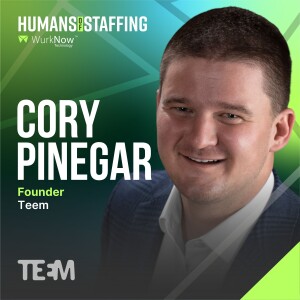
The staffing industry has undergone significant transformation, but few have approached it with the unique perspective of Cory Pinegar, Founder of Teem. In this episode of Humans of Staffing, Cory shares how a chance opportunity to clean out a closet for $500 led to acquiring a struggling dental service division for just $1. From those humble beginnings — where making payroll sometimes depended on collecting from a single difficult client — he's built a global staffing operation that now maintains a stringent 0.4% acceptance rate to ensure quality.
What makes Cory's approach revolutionary is his insight into healthcare staffing challenges: dentists receive only about two weeks of business training during four years of dental school, leading to emotional rather than data-driven decisions. Teem addresses this by providing comprehensive performance dashboards that transform perceived "busyness" into measurable value, showing exactly how many calls were answered and appointments scheduled. Although focusing initially on dental practices, Pinegar has strategically expanded into optometry and veterinary markets, creating sustainable staffing solutions that bridge cultural gaps and deliver consistent results in an industry where reliability trumps cost savings.
Topics Discussed:
Transforming a struggling quarter-million-dollar service division into a multimillion-dollar operation serving thousands of dental practices, highlighting the importance of recognizing opportunity in unexpected places.
Despite being extremely knowledgeable clinically, dental practitioners receive just two weeks of business training during four years of dental school, creating a significant disconnect between clinical and operational excellence that creates market opportunities.
The dramatic shift from less than 10% private equity ownership in dental practices eight years ago to over 25% today, and how rising interest rates have slowed acquisition trends that once projected to reach 35% market penetration.
How implementation of performance tracking dashboards provides dental practice owners with unprecedented visibility into metrics like calls answered, appointments scheduled, and insurance verifications, replacing "busyness" perception with measurable value.
The evolution from outsourcing merely for cost reduction to strategic staffing for reliability and loyalty, with a rigorous vetting process that selects just 0.4% of applicants.
Rejecting the "us versus AI" mentality in favor of integrating AI as a productivity multiplier for human workers while preserving the human connection clients still demand, particularly in healthcare settings requiring trust and empathy.
Growing a business organically with a focus on solving real customer problems rather than pursuing the "pump and dump" model prevalent in venture-backed startups, with clear pillars: hiring exceptional people, providing thorough training, ensuring value visibility, and AI enablement.
Strategically focusing on regions where regulatory complexity and bilingual requirements create higher demand for staffing solutions, particularly in states like California, Texas, and Florida where labor costs and compliance burdens are highest.
Creating intentional but organic momentum in healthcare verticals where decision-makers exhibit herd mentality, focusing on penetrating the crucial early-adopter segment that influences the broader market.
Democratizing access to international talent that was previously available only to large corporations, providing complete infrastructure including employer of record services, compliance management, and performance analytics.
Listen to more episodes:
Apple
Spotify
YouTube
Website
Thursday May 08, 2025
Thursday May 08, 2025
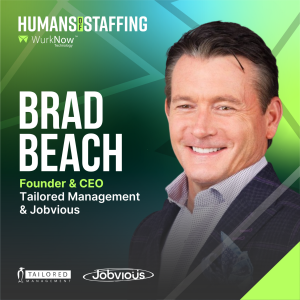
Staffing industry margins are under unprecedented pressure, and Brad Beach, Founder & CEO of Jobvious & Tailored Management, has responded by creating a platform that fundamentally reimagines the economics of talent acquisition. After 30 years witnessing staffing agencies squeezed between MSP fees, shrinking markups, and intensifying competition, Brad launched a referral-based platform that compensates "network champions" with 10% of a placed candidate's hourly wage for the entire duration of their assignment. This approach doesn't just create significant passive income opportunities; it taps into the 85% of qualified talent not actively searching job boards while simultaneously reducing recruiting costs.
In this episode of Humans of Staffing, Brad tells Sammy and TJ the entrepreneurial journey that led to this innovation, his "free to fail" leadership philosophy that fosters organizational creativity, and his predictions about the future of contingent labor — including why he believes MSPs are facing extinction. With clients increasingly seeking global talent solutions and digital transformation reshaping traditional staffing models, Brad offers invaluable insights for anyone navigating the rapidly evolving future of work.
Topics Discussed:
How Brad's incentive-based referral platform creates annuity-like income streams for network members while accessing passive talent not found on traditional job boards.
Why traditional models with 75+ vendors competing for requisitions at 6-7% submission-to-hire ratios have become financially unsustainable.
Building an autonomous "free to fail" organizational culture that encourages innovation by empowering employees to question established processes without fear of repercussion.
Why most internal referral programs fail to drive meaningful results and how ongoing percentage-based compensation creates far stronger motivation than one-time bonuses.
The strategic shift toward global contingent workforce solutions, with Brad seeing more international staffing requests in the past six months than the previous 15 years combined.
Why direct sourcing initiatives often disappoint despite their theoretical appeal, and how they often recreate the old "vendor on premise" model without acknowledging it.
How artificial intelligence will reshape staffing operations while still requiring human judgment for candidate-client relationship management and complex placement decisions.
The emerging trend of enterprises bringing contingent labor management in-house as MSPs struggle to demonstrate continuing value in the modern staffing ecosystem.
Creating sustainable vendor relationships through transparency rather than constantly adding suppliers.
Listen to more episodes:
Apple
Spotify
YouTube
Website